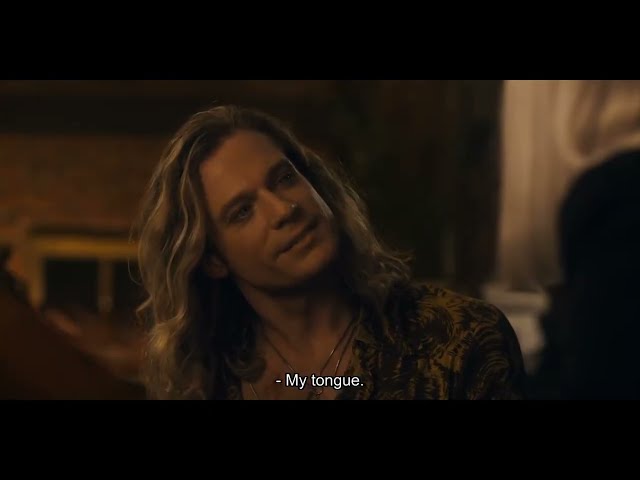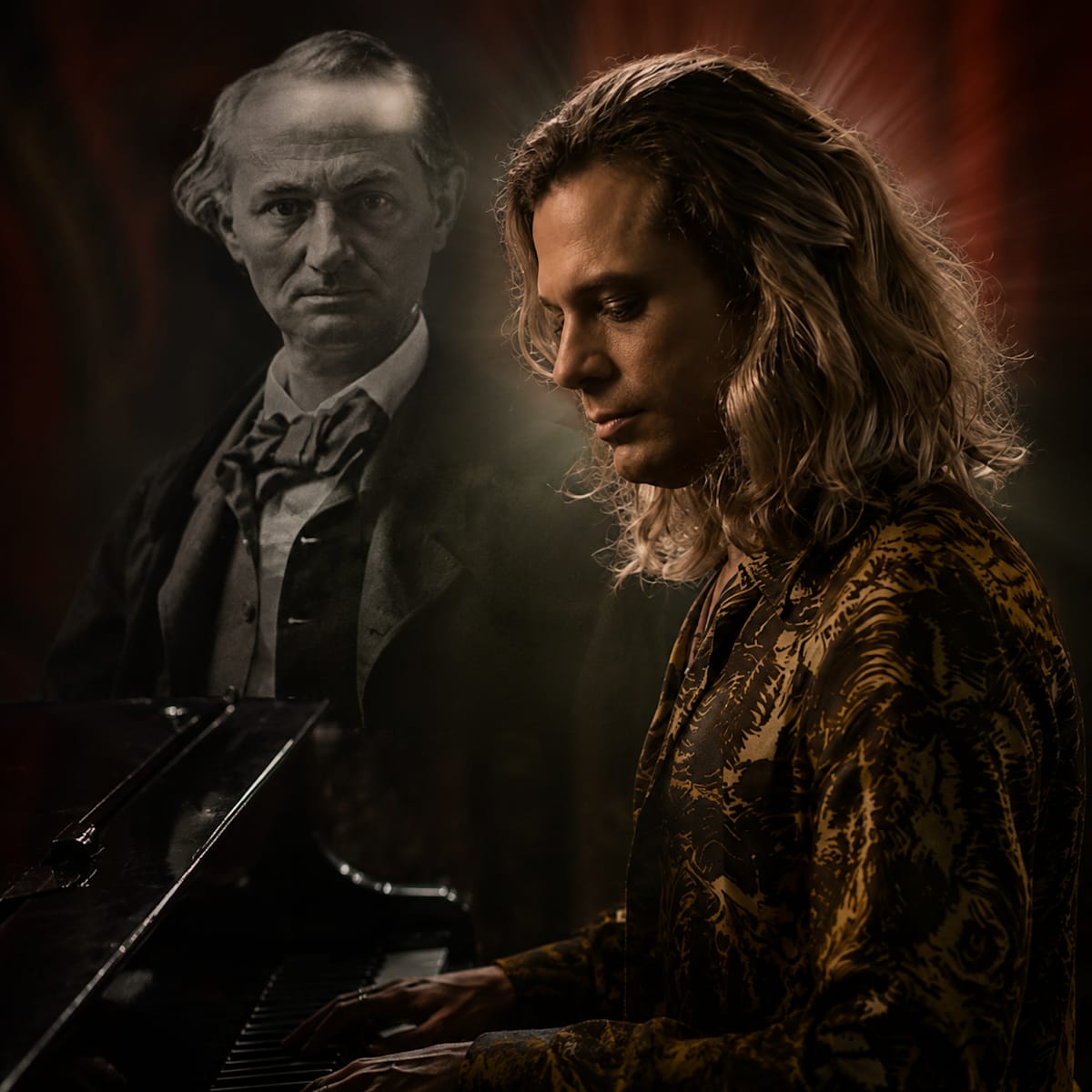
The best poetry doesn't always live inside books. Sometimes it's tucked into a favorite song, sometimes it slips through a film's dialogue, and sometimes it takes the stage in velvet, fangs, and the swagger of an immortal rock star. Or, in this case, the brilliant actor Sam Reid, who has finally given me the Lestat I read on the page, all those decades ago.
While watching Interview with the Vampire, there was a moment that made the poet in me grin from ear to ear. Lestat sits at the piano and begins singing Charles Baudelaire, in French. I actually laughed because, honestly... of course he does. If you've never read Baudelaire, the scene is still mesmerizing. It's dark, beautiful, and haunting in exactly the way you'd expect from Lestat. However, if you've spent any time wandering through Baudelaire's poetry, the scene becomes an inside joke between artists separated by nearly two centuries.
There's a quote I've always loved: "Perhaps to really like Baudelaire you have to be a little morbid." (Dan Yorty) I can't say I disagree. Baudelaire isn't interested in pretending the world is prettier than it is. He writes about death, desire, decay, longing, intoxication, loneliness, and the strange beauty that can grow from suffering. His poems don't flinch. They stare directly into the darkness and somehow find flowers growing there anyway, which feels fitting when you remember that his most famous collection is The Flowers of Evil.
When that collection was published in 1857, French authorities prosecuted Baudelaire for offending public morality, and six of the poems were banned. Imagine writing poetry so provocative that the government decides your imagination is dangerous. How punk rock is that? It’s also why Baudelaire still feels startlingly modern. Every generation eventually discovers that life isn’t divided neatly into beauty and ugliness, innocence and corruption, light and darkness. More often than not, they exist together. Every poet hopes to outlive their own century. Baudelaire didn’t just outlive his he became immortal through other people's stories.
Lestat has always been a contradiction. He can be impossibly charming one moment and absolutely monstrous the next. He collects art, music, philosophy, and lovers with the same hunger he has for blood. That's why Baudelaire never felt like an arbitrary choice to me. Of all the poets he could have sung, Baudelaire feels inevitable, not because he's a French goth but because they are fascinated by the same questions. How can beauty exist beside horror? Can love survive corruption? Is darkness something to fear, or simply another room in the human soul?
It's no accident that Baudelaire found his way into Lestat's repertoire. Anne Rice adored him. His influence can be felt throughout The Vampire Chronicles, not simply in the quotations or references, but in the atmosphere of the books themselves. Like Baudelaire, Rice understood that beauty and monstrosity aren't opposites but rather companions. Her vampires are sensual and philosophical, forever wrestling with guilt, longing, mortality, and desire. All the same questions Baudelaire explored more than a century before Rice ever put pen to paper.
That's what I love most about discovering these literary threads. A nineteenth-century French poet scandalizes Paris with The Flowers of Evil. More than a hundred years later, Anne Rice draws from that same well of beauty and darkness to create one of literature's most unforgettable vampires. Decades after that, Interview with the Vampire brings Baudelaire back into the spotlight by having Lestat sing his words in French. Suddenly a new generation hears a haunting poem, wonders who Baudelaire is, and tumbles down a rabbit hole into poetry.
Moments like this make my little poetry heart flutter because they remind me that poetry has never disappeared. We imagine poetry as something confined to anthologies and classrooms, but it's always been hiding in plain sight. It's entwined in our favorite songs, whispered through films, tucked inside novels, and waiting patiently for someone curious enough to follow the thread backward. (Those beautiful silver strings.)
That's one of the reasons I wanted to start Poetry Hidden in Pop Culture. As a poet, I notice these literary breadcrumbs everywhere. Sometimes they're obvious. Sometimes they flash by so quickly that if you blink, you'll miss them. I want to follow those threads together and uncover the poets quietly haunting our favorite books, films, television shows, and music. Poetry is alive and well; it just changes costume from time to time. And sometimes, that costume belongs to a hot vampire singing Baudelaire in French.
This is the first installment of Poetry Hidden in Pop Culture, a series exploring the poems, poets, and literary references quietly haunting our favorite books, films, television, and music. Found a poem hiding in your favorite movie, show, or song? Tell me where. It might just become the next installment of Poetry Hidden in Pop Culture.
Enjoyed this post? Subscribe to my Substack for more essays exploring where poetry hides in pop culture, mythology, and everyday life. https://substack.com/@stashastrange